This is a follow-up to our article 10 Massive Environmental Projects Reshaping America.
When people picture a Superfund cleanup, they usually picture the contamination: a canal black with coal tar, a tank farm full of radioactive sludge, a hill of mine waste taller than a 15-story building. What they don’t picture is everything it takes to work safely on top of it.
Behind every major cleanup is an operation that looks a lot like a small city: equipment fleets, water treatment, haul routes, laydown yards, decontamination stations, air monitoring, power, offices, sanitation and a supply chain that has to keep running for years, sometimes decades.
To show what that looks like in practice, we looked at three very different sites on, or tied to, the federal cleanup program: the Hanford Site in Washington, the Gowanus Canal in Brooklyn and Tar Creek in northeast Oklahoma. Each one is a lesson in what it actually takes to equip a Superfund site.
Hanford, Washington: Cleanup at Industrial Scale
From 1944 to 1989, Hanford produced plutonium for the country’s nuclear weapons program. The result is one of the most complex environmental cleanups in the world. According to the DOE Office of Environmental Management, about 56 million gallons of radioactive and chemical waste sit in 177 large underground tanks, organized into 18 tank farms.
Progress is measured one tank at a time. By August 2026, crews had retrieved about 3.5 million gallons of waste from 24 of the older single-shell tanks, transferring it into newer double-shell tanks for safer storage while treatment capacity comes online.
What it takes to equip it: Hanford is the extreme end of the spectrum. Waste retrieval relies on specialized remote systems, but the site also depends on an enormous amount of conventional support: earthmoving for barriers and disposal cells, cranes and rigging for removing and installing in-tank equipment, generators and temporary power, contamination-controlled work tents, worker trailers, and a constant flow of light-duty vehicles moving crews across a very large site. When hundreds of workers are spread across miles of controlled areas, fleet availability and maintenance logistics become a schedule issue, not just a cost issue.
Gowanus Canal, Brooklyn: Remediation in a Dense City
The Gowanus Canal is a 1.8-mile waterway in the middle of Brooklyn, and EPA has described it as one of the nation’s most seriously contaminated water bodies. More than a century of industrial discharges, including from manufactured gas plants, and combined sewer overflows left thick layers of contaminated sediment on the bottom. EPA added the canal to the Superfund list in 2010, and full-scale dredging began in November 2020.
The work is done in stages. Dredging and capping of the upper section was scheduled for completion in 2024, and EPA issued an order that year for a $369 million cleanup of the middle section. The agency estimates the overall cleanup plan, including sewer overflow controls, at more than $2 billion. You can follow the project on EPA’s Gowanus Canal site page.
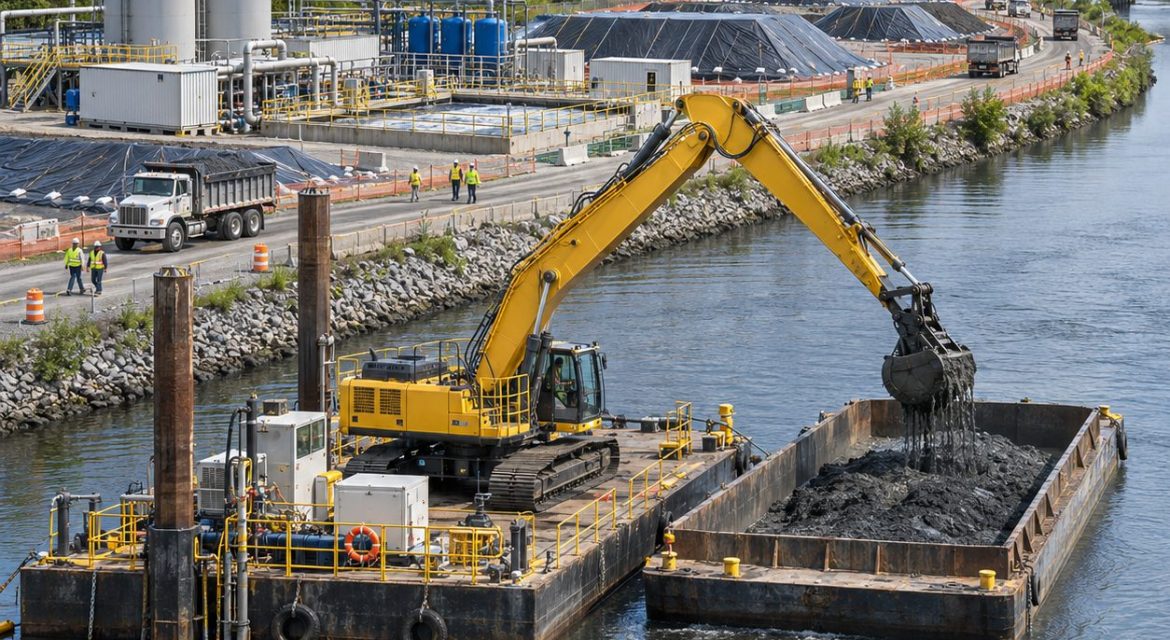
What it takes to equip it: on Gowanus, the challenge is space. Work happens from barges, with excavators mounted on floating platforms, because there is no room along much of the canal for land-based equipment. Dredged sediment has to be moved, dewatered and processed, which means barges, material handling equipment, water management systems and staging areas, all inside a dense residential and commercial neighborhood. Noise, odor, traffic and air monitoring are part of the daily plan. On urban sites like this, a well-run laydown and staging operation can matter as much as the dredging equipment itself.
Tar Creek, Oklahoma: Moving Mountains of Mine Waste
Lead and zinc were mined in far northeast Oklahoma from 1891 until 1970. What was left behind is the Tar Creek Superfund Site, roughly 40 square miles of Ottawa County that EPA placed on the National Priorities List in 1983, making it one of the oldest Superfund sites in the country.
The most visible legacy is “chat,” the gravel-like mill tailings that contain lead, zinc and cadmium. Some of the chat piles have stood up to 200 feet high, and a 2019 EPA strategic plan counted more than 40 million tons of chat across 105 piles. Tar Creek is also historic for another reason: in 2012 EPA signed an agreement making the Quapaw Nation the first tribe to lead the cleanup of a federal Superfund site. The Oklahoma DEQ Tar Creek page has the current status.
What it takes to equip it: Tar Creek is a classic earthmoving job with an environmental twist. Moving millions of tons of material requires loaders, excavators, articulated haul trucks, screening plants and water trucks for dust control, all operating with contamination controls and air monitoring. Haul routes have to be built and maintained, equipment has to be decontaminated before it leaves the work area, and residential yard cleanups bring smaller equipment into neighborhoods. Fleet uptime and fuel logistics drive production on a site this size.
What Every Major Cleanup Has in Common
A nuclear tank farm, an urban canal and a former mining district could hardly be more different. But when you look at what keeps the work moving, the same needs show up on all three:
- Equipment that matches the site, not the brochure. Barge-mounted excavators on Gowanus, haul fleets at Tar Creek, cranes and rigging at Hanford. The right configuration matters more than the biggest machine.
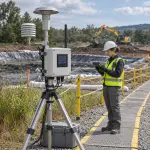
- Water management everywhere. Dewatering, treatment, dust control and stormwater show up on every remediation project, whatever the contaminant.
- Decontamination as a production step. Every piece of equipment leaving a contaminated area has to be cleaned, so decon capacity can limit production.
- Laydown, staging and logistics. Materials, equipment and waste all need a place to go. On tight sites, staging space is often the scarcest resource.
- Safety and monitoring infrastructure. Air monitoring, exclusion zones, worker facilities and site security are permanent parts of the job, not add-ons.
- Long timelines. These projects run for years. Fleet maintenance, replacement and flexibility to scale up or down are built into the plan.
Lessons for Contractors Bidding Cleanup Work
For primes and subcontractors pursuing Superfund, DOE and state cleanup work, these sites point to a few practical lessons:
Plan the support operation as carefully as the remedy. The cleanup method gets the attention in a proposal, but site support, laydown, fleet and logistics determine whether the schedule holds. A turnkey laydown yard or a single-source equipment rental and fleet management partner can take a lot of that burden off the project team.
Expect conditions to change. Multi-year cleanups move through phases with very different equipment needs. Renting gives you the flexibility to change the fleet when the work changes, instead of owning equipment that fits only one phase. We cover the cost side of that in The 5 Equipment Mistakes That Blow Up Remediation Budgets.
Build your small-business strategy into the plan. Federal cleanup contracts typically carry small-business subcontracting goals. Equipment rental, site services and logistics are real scopes of work that a certified small business can perform with a commercially useful function. Our SBE Fulfillment article covers how primes approach that.
The Bottom Line
America’s biggest cleanups are remarkable feats of science and engineering. They are also, day to day, very large construction operations that run on equipment, logistics and people. The contractors who succeed on them are the ones who treat the support operation as part of the remedy, not something to sort out after mobilization.
If you want to dig deeper into the projects shaping environmental contracting right now, start with 10 Massive Environmental Projects Reshaping America and our look at six projects across six industries.
Frequently Asked Questions
What is a Superfund site?
A Superfund site is a contaminated location addressed under the federal Comprehensive Environmental Response, Compensation, and Liability Act (CERCLA). The most serious sites are placed on EPA’s National Priorities List. Learn more on EPA’s Superfund page.
What equipment is used at a Superfund site?
It depends on the site, but most cleanups use excavators, loaders and haul trucks, dewatering and water treatment systems, decontamination equipment, air monitoring, generators and lighting, and site support such as trailers, sanitation and laydown space. Sediment sites add barges and dredging equipment.
How long does a Superfund cleanup take?
Large cleanups often take many years. Tar Creek was listed in 1983 and work continues today, and Hanford’s tank waste mission is planned through 2040 and beyond.
About Nimble Managed Services
Nimble is a government-certified small-business set-aside partner providing managed services to construction, engineering, environmental, federal and infrastructure contractors.
Nimble currently lists certifications including WOSB, EDWOSB, HUBZone, SDB, DBE and SBE, along with additional state and utility certifications. Its managed-service capabilities include equipment rental and fleet management, turnkey laydown yards, subcontract management, site services, construction technologies, sustainability support and compliance consulting.
Learn more about Nimble’s Small Business Advantage
Bidding on a Superfund or federal cleanup? Let’s talk through the equipment, laydown and site support plan early, while it can still shape the proposal. Start a conversation with the Nimble team.