Questions We Hear All the Time (And Our Honest Answers)
The questions prime contractors and PMs ask most often about managed subcontracts services — vendor relationships, CUF documentation, scaling mid-project — answered without the sales pitch.
Most fleets have telematics data; few actually use it. Here’s what idle-time tracking, ghost-asset visibility, and predictive maintenance are actually worth — and how a unified platform turns the data into decisions.
A global contractor arrived in Pennsylvania for a multi-year remediation project with no local network. Here’s how Nimble coordinated five service lines — laydown yard, fleet, technology, sustainability reporting, and subcontracts — under one team.
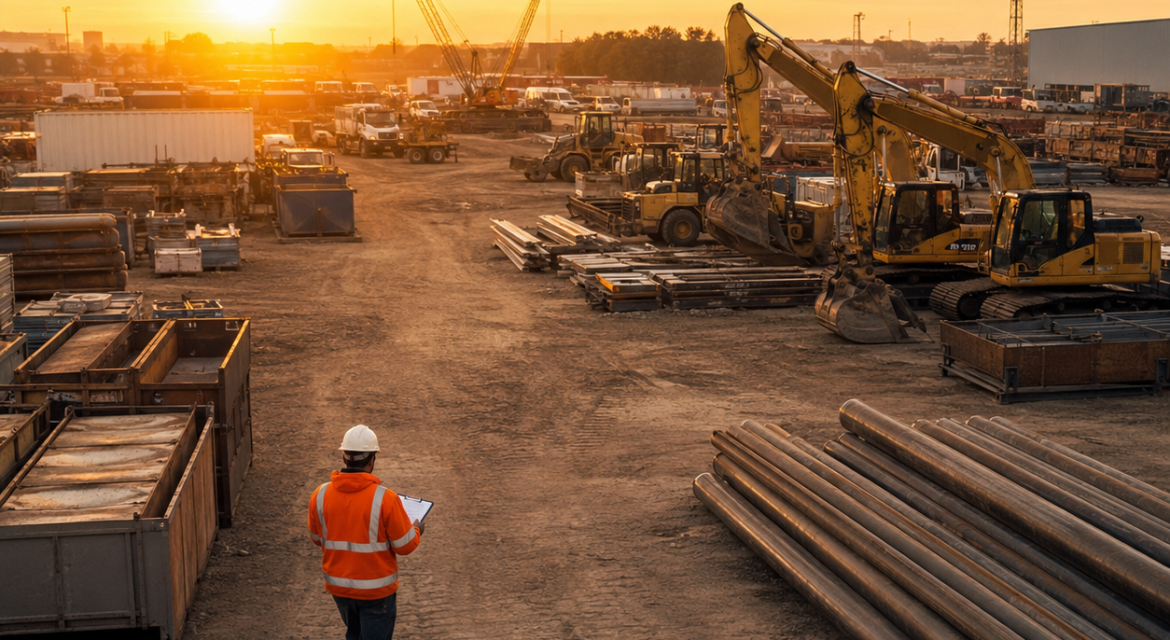
Supervisors can lose 35-45% of their time just locating materials and equipment on a disorganized yard. Here’s why laydown yard management is getting harder, and what a well-run yard actually looks like.
The Evaluation Standard Shifted As 2025 closed, one thing became clear across U.S. construction and infrastructure projects: set-aside participation is no longer judged primarily by eligibility. The market didn’t abandon compliance—but it stopped treating it as a differentiator. In 2025, many procurement teams were still focused on meeting participation
Why Renting AI-Enabled Equipment Is Becoming the New Safety Standard Job site safety isn’t abstract — it’s measurable, and the numbers are sobering. More than 60,000 job site fatalities occur worldwide every year, and incidents involving heavy equipment remain a persistent risk across the construction industry. Even more concerning:
The remediation market is transforming. It’s no longer about responding to liabilities; it’s about leading complex, data-driven, and sustainable restoration programs. For Project Managers (PMs) at a large environmental consulting company, success in 2026 will depend on mastering the technical complexities and strategic delivery of these five high-growth program areas.
Set-aside programs were designed to create opportunity—but opportunity alone doesn’t build operational maturity. Across federal contracting, thousands of small businesses achieve certification but stall when facing enterprise-level project demands. The paradox? The very firms meant to bridge the gap between policy and performance often lack the systems to compete where
Hyperscale data centers—the massive digital backbones supporting cloud computing and AI—are among the most complex builds in modern construction. Every piece of equipment, from tower cranes to telehandlers, must be orchestrated with precision. Even a few hours of downtime can ripple through the supply chain and cost millions in lost
In the age of smart infrastructure, the most valuable assets aren’t the machines on site—they’re the insights behind them. Every modern project produces mountains of data: fleet movement, material delivery, equipment utilization, and fuel efficiency. The contractors that can interpret that data fastest are redefining what it means to build