
This is a follow up to our article The Top 10 Massive Environmental Projects Reshaping America found here:
https://www.nimblems.com/construction/10-massive-environmental-projects-reshaping-america/
On a billion-dollar infrastructure project, small-business participation can represent a lot more than a line item in a compliance report. It can represent millions, sometimes tens of millions, of dollars in actual subcontracting opportunities.
The question for a prime contractor is what to do with that spend. Treat it as an obligation that has to be filled? Or use it strategically to bring capable small-business partners into scopes the project already needs?
For environmental, remediation, infrastructure and federal contractors, that distinction matters.
First, What Does “SBE Spend” Actually Mean?
“SBE” is often used broadly in the construction industry, but there isn’t one universal SBE program or one percentage that applies to every project.
Federal contracts can involve several small-business goal categories:
- Small Business
- Small Disadvantaged Business (SDB)
- Women-Owned Small Business (WOSB)
- HUBZone
- Service-Disabled Veteran-Owned Small Business (SDVOSB)
State and local projects may use SBE, DBE, M/WBE or other certification programs, each with its own eligibility and crediting rules.
At the federal level, the government-wide goal is to award 23% of prime contracting dollars to small businesses. Additional government-wide goals include:
- 5% — women-owned small businesses
- 5% — small disadvantaged businesses
- 3% — HUBZone firms
- 5% — service-disabled veteran-owned small businesses
Individual agencies can have their own negotiated goals.
See the SBA’s federal small-business contracting goals
But those government-wide numbers are only part of the story. For large federal contracts awarded to businesses that are not small businesses, subcontracting plans can become a contractual requirement — under current federal acquisition rules, solicitations and contracts that offer subcontracting possibilities and are expected to exceed $900,000, or $2 million for construction of a public facility, generally trigger small-business subcontracting-plan requirements when the applicable conditions are met.
Those plans don’t simply say, “Use some small businesses.” They establish separate goals for small businesses and socioeconomic categories and identify the dollars and types of supplies and services expected to be subcontracted, and contractors also have reporting obligations so the government can evaluate performance against the plan.
Read FAR 52.219-9: Small Business Subcontracting Plan
That is where SBE strategy becomes much more interesting.
The Dollars Get Big Fast
Consider the scale of the projects we covered in our recent look at some of America’s largest environmental and resilience projects. These aren’t $5 million construction jobs — they’re projects and programs measured in hundreds of millions or billions of dollars.
And some of them provide a very clear picture of what small-business participation can look like in the real world.
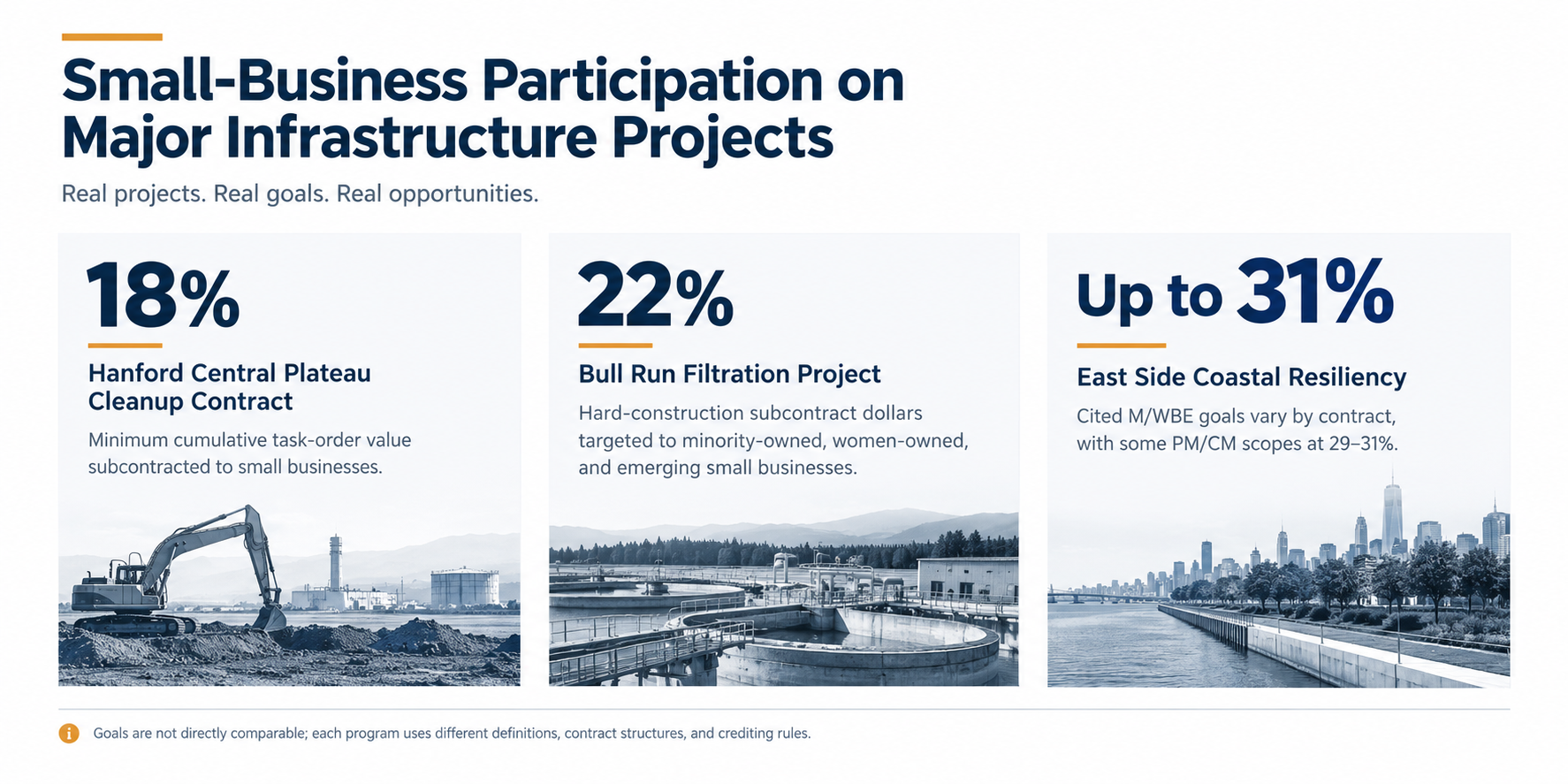
Hanford: Small Business Built Into a Massive Cleanup Mission

The Hanford Site in Washington is one of the largest and most complicated environmental cleanup efforts in the country. More than 13,000 people are involved in Hanford’s day-to-day operations, with multiple Department of Energy prime contractors responsible for different parts of the cleanup mission.
Small business isn’t an afterthought in that contracting structure. The current Central Plateau Cleanup Contract requires the contractor to subcontract at least 18% of the cumulative value of task orders to small businesses, subject to the contract’s definitions and exclusions.
The contract also establishes minimum goals for several categories:
| Small-Business Category | Minimum Goal |
|---|---|
| Small Disadvantaged Business | 5% |
| Women-Owned Small Business | 5% |
| HUBZone | 3% |
| Veteran-Owned Small Business | 3% |
| Service-Disabled Veteran-Owned Small Business | 3% |
Those percentages are applied according to the contract’s task-order subcontracting provisions; they should not be read as percentages of Hanford’s entire lifecycle cleanup estimate. That’s an important distinction, but it also illustrates the opportunity.
Small businesses at Hanford aren’t limited to performing one narrow type of field construction — Hanford’s prime contractors procure an enormous range of capabilities needed to keep the cleanup operation moving. Hanford Mission Integration Solutions, for example, describes subcontracted activities ranging from analytical and sampling services to infrastructure and mission-support functions.
DOE continues actively recruiting small businesses into the Hanford supply chain. Its May 2026 Bridging Partnerships Small Business Symposium drew more than 300 attendees specifically to connect small businesses with Hanford prime contractors and help firms understand the subcontracting process.
Bull Run: 22% of Hard-Construction Subcontract Dollars

Portland’s $2.46 billion Bull Run Filtration Project provides another example, this time outside the traditional federal small-business structure. The project’s construction contracts include community-benefits agreements with contracting and workforce equity commitments.
For hard-construction subcontract dollars, the contracting goal is 22%, consisting of:
- 12% minority-owned businesses
- 5% women-owned businesses
- 5% emerging small businesses
The project also established workforce goals, including minority and women participation in apprentice and journey-worker hours.
Twenty-two percent is not pocket change on major construction packages, and that is exactly why the conversation should go beyond simply finding enough certified companies to satisfy a percentage. The better question is:
What work does the project already need that a qualified small-business partner can take responsibility for?
East Side Coastal Resiliency: Goals Vary Even Within One Project
New York City’s East Side Coastal Resiliency project provides another useful lesson: there isn’t necessarily one participation percentage applied uniformly across every contract.
For Project Areas 1 and 2, a 2025 project update reported different M/WBE goals depending on the contractor and scope:
| Contractor / Role | M/WBE Goal |
|---|---|
| HNTB-LiRo, PM/CM — Project Area 1 | 29% |
| HNTB-LiRo, PM/CM — Project Area 2 | 31% |
| IPC Resiliency Partners, GC — Project Area 1 | 16% |
| Perfetto, GC — Project Area 2 | 12% |
At the time of that report, Perfetto was exceeding its goal, while the other teams were at different stages of progress toward theirs. New York City specifically directs local M/WBE and Section 3 firms toward subcontracting opportunities associated with the project.
See ESCR contracting opportunities
This is an important point for primes: there is no magic SBE percentage. The requirement can change by owner, agency, funding source, certification, contract, task order and even the type of work being performed.
So What Does “Making SBE Spend Work Harder” Mean?
It does not mean finding creative ways to move invoices through a certified company. It means identifying real scopes of work that the project already needs and asking whether a qualified small business can actually perform and manage that scope. That’s a very different approach.
Instead of beginning with:
“We need another $X in SBE spend. What can we buy?”
Start with:
“What are we already buying, renting, coordinating or managing that could become a legitimate small-business subcontract?”
On a major environmental or infrastructure project, that list can be surprisingly long:
- Equipment rental
- Fleet management
- Temporary site infrastructure
- Laydown yards
- Fuel
- Pumps and filtration equipment
- Mobile offices
- Storage containers
- Temporary fencing
- Waste services
- Site services
- Survey and grade-control technology
- Sustainability reporting
- Materials
- Transportation
- Vendor coordination
- Subcontract administration
Those aren’t artificial scopes created to hit a goal — they’re things large projects already spend money on.
One Managed Scope Instead of 20 Vendors
This is where the Nimble managed-services model becomes particularly useful. Imagine a prime contractor mobilizing a remote environmental remediation project.
The project needs:
- Excavators and earthmoving equipment
- Water trucks and pumps
- Office trailers
- Storage containers
- Temporary fencing
- Portable restrooms
- Fuel service
- Survey and grade-control equipment
- Waste removal
- Equipment tracking
- Multiple local service providers
Traditionally, the project team might establish separate vendor relationships for each category — separate quotes, POs or subcontracts, invoices, contacts, delivery schedules, insurance documentation, problems and closeout requirements.
Now consider a different structure. A qualified small-business managed-services partner takes responsibility for an eligible scope encompassing several of those needs, and the prime still receives the equipment and services required to execute the project.
But instead of small-business participation existing separately from operations, the small-business subcontract becomes part of the operational solution. That’s what we mean by making SBE spend work harder.
A Real-World Example
This isn’t hypothetical for Nimble. On a remote military project in Utah, a global federal environmental contractor faced both limited local supplier relationships and stringent small-business participation requirements.
Nimble provided managed procurement and coordinated multiple project needs, including:
- A turnkey laydown yard
- Office trailers
- Portable sanitation
- Storage containers
- Temporary fencing
- Fueling
- Heavy equipment
- Pumps
- Grade-control systems
- Subcontracted materials and transportation
The result was not simply “SBE spend” — it was a functioning project-support scope being performed through a small-business partner.
See Nimble’s subcontract-management examples
That’s the distinction that matters.
Certification Alone Isn’t Enough
There is an obvious trap here: a company can possess the right certification and still be the wrong project partner. The prime contractor ultimately needs performance.
That means evaluating the small-business partner much the same way it would evaluate any other critical subcontractor:
- Can it perform the scope?
- Does it have the people and systems to manage it?
- Can it support a project in multiple locations?
- Can it manage suppliers instead of simply forwarding invoices?
- Can it provide accurate reporting?
- Can it respond when equipment goes down or a field requirement changes?
- Can it document what it actually did?
And, critically, will the work legitimately qualify for the applicable small-business credit under that particular contract? That last question has to be answered before the spend is counted.
CUF Still Matters
Particularly on programs involving DBE/SBE participation rules, contractors also need to pay close attention to Commercially Useful Function, or CUF, requirements and the specific rules governing how participation credit is calculated.
A certified company cannot simply exist between the prime contractor and another vendor for the purpose of generating participation credit — the structure has to comply with the applicable program and contract.
That’s one reason managed services can be valuable when they’re structured correctly: the small business isn’t merely appearing on an invoice. It is performing a defined function, managing its scope and providing actual value.
But certification alone does not determine whether a particular expenditure counts. The governing solicitation, contract, subcontracting plan and agency rules control.
This Is Also a Proposal Strategy
The best time to think about small-business participation isn’t six months into construction when someone realizes the project is behind its goal — it’s during estimating and proposal development.
Look at anticipated spend before mobilization:
- Where will the project spend money on equipment?
- What recurring site services will be required?
- What temporary infrastructure will be needed?
- What categories are likely to involve multiple vendors?
- What work can reasonably be subcontracted?
- Which certification categories apply?
- And which qualified partners can be brought into the proposal early?
Federal rules actually require subcontracting plans to identify the principal types of supplies and services expected to be subcontracted to small and socioeconomic-category businesses. That’s a clue: small-business strategy should be tied to the project’s procurement strategy from the beginning.
The Opportunity Is Bigger Than Compliance
Small-business programs exist to create meaningful opportunities for capable businesses to participate in government and publicly funded work. For primes, meeting those commitments is part of doing the job — but there is no reason compliance and operational value have to work against each other.
Hanford demonstrates how deeply small-business subcontracting can be embedded into one of America’s largest environmental cleanup missions. Bull Run shows a major water project directing 22% of hard-construction subcontract dollars toward targeted business categories. And East Side Coastal Resiliency shows participation goals reaching 29% and 31% on major PM/CM scopes, while different construction packages carry their own goals.
Those aren’t insignificant numbers — they represent real scopes, real businesses and real project dollars.
The strongest strategy isn’t to ask “How do we fulfill our SBE requirement?” It’s to ask “How much of the work we’re already doing can be performed by capable small-business partners?”
That turns small-business participation from a compliance exercise into part of the project’s procurement and execution strategy. And that is what going beyond the SBE requirement really means.
About Nimble Managed Services
Nimble is a government-certified small-business set-aside partner providing managed services to construction, engineering, environmental, federal and infrastructure contractors.
Nimble currently lists certifications including WOSB, EDWOSB, HUBZone, SDB, DBE and SBE, along with additional state and utility certifications. Its managed-service capabilities include equipment rental and fleet management, turnkey laydown yards, subcontract management, site services, construction technologies, sustainability support and compliance consulting.
Learn more about Nimble’s Small Business Advantage
Planning your next proposal? Bring the SBE strategy into the conversation while you’re still building the scope, not after the project has already started.