Looking for the bigger picture on job site safety tech? Start with The Safety Technology Changing What “Safe Job Site” Actually Means. This article focuses on what’s different on remediation sites.
A remediation site asks a lot of its crew. Workers operate heavy equipment around excavations, often in protective gear that limits visibility and hearing, on ground that may release vapors, dust or worse. Conditions can change in the time it takes to dig one more bucket.
That’s why remediation has become one of the most interesting places to watch safety technology. The tools aren’t new on their own, but on hazardous waste sites they solve problems that ordinary construction sites don’t face. We covered job site safety technology broadly in a previous article. Here we look at what’s changing on remediation sites specifically in 2026.
1. Real-Time, Connected Air Monitoring
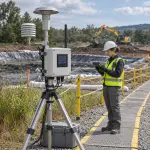
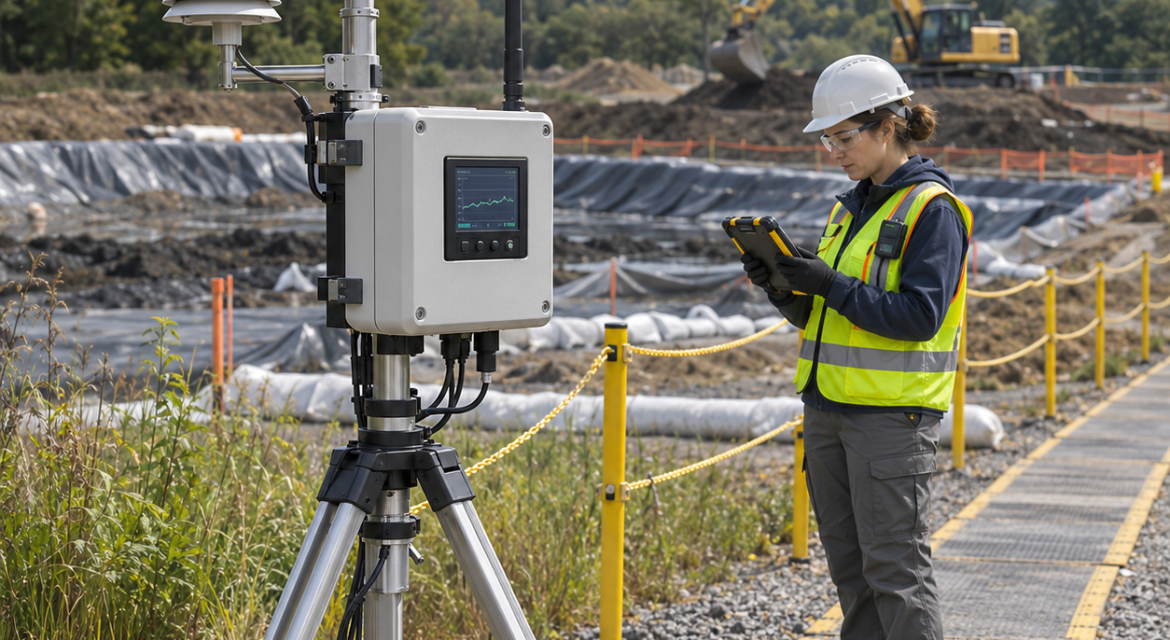
Air monitoring has always been part of remediation, but it used to mean handheld readings, clipboards and samples sent to a lab. Today, networks of connected monitors at the work zone and the site perimeter report particulates, volatile organic compounds and other gases in real time, along with wind speed and direction.
Why it matters on remediation sites: action levels can be tracked continuously, alerts go to supervisors’ phones the moment readings rise, and the data creates a record that protects the project if neighbors or regulators raise concerns. Pairing monitors with weather data also helps teams understand where emissions are heading, not just where they are.
2. Connected Personal Gas Detection
Personal gas detectors are standard on many hazardous waste sites. What’s changing is connectivity. Newer detectors can send readings and alarms to a central dashboard, so a supervisor knows immediately when a worker’s detector goes into alarm, and where that worker is.
Why it matters: in confined areas, trenches and around excavations into unknown materials, seconds matter. Connected detection also simplifies documentation for exposure monitoring.
3. Proximity Detection Around Heavy Equipment
Struck-by incidents are a major hazard anywhere heavy equipment works near people. On remediation sites, the risk is higher because protective suits, respirators and hearing protection make it harder for workers to see and hear approaching machines.
Proximity detection systems use tags worn by workers and sensors on equipment to warn operators and workers when they get too close. Some systems can slow or stop machines automatically. We explain how these systems are deployed in our safety-as-a-service program, and OSHA’s construction safety resources cover the underlying hazards.
4. Drones for Site Surveys and Inspections
Drones are now a routine tool for surveying stockpiles, tracking excavation progress and inspecting areas that are hard or risky to reach on foot. On remediation sites, that means fewer people walking through contaminated areas just to look.
Why it matters: volume measurements of contaminated stockpiles help track waste and disposal, regular aerial images document progress for regulators, and inspections of caps, berms and slopes can be done quickly after storms.
5. Remote and Assisted Equipment Operation
Remote-controlled and semi-autonomous equipment are moving from niche to practical on the most hazardous tasks. Some of the most complex federal cleanups already rely on remote systems for high-hazard work. On more typical sites, remote-capable demolition machines, compact equipment and machine guidance systems reduce the time workers spend in the most dangerous zones.
Why it matters: the safest exposure is no exposure. Removing the operator from the hazard, even part of the time, reduces risk on tasks like handling unknown materials or working near unstable excavations.
6. Telematics and Equipment Health Data
Telematics usually comes up in conversations about cost and utilization, but it is also a safety tool. Engine alerts, fault codes, hours and location data help catch maintenance problems before they lead to a failure in the field. Geofencing can alert supervisors when equipment enters an area it shouldn’t, such as an exclusion zone boundary.
We cover how teams actually use that data in Beyond the Dashboard, and our advanced construction technologies page shows what’s available.
7. Heat Stress Monitoring
Protective suits trap heat. On a summer day, a worker in Level C or Level B protection can face serious heat stress risk long before anyone else on site feels uncomfortable. Wearable sensors that track body temperature indicators and heart rate, combined with site weather data, are helping teams plan work-rest cycles and spot trouble early.
OSHA’s heat exposure guidance and its HAZWOPER resources are good starting points for building a program.
Making Safety Tech Work on Your Site
The best technology fails if nobody uses it. The remediation teams getting the most out of these tools tend to follow a few practical rules:
- Start with the hazards. Choose technology based on the site’s contaminants, equipment and tasks, not on what’s new.
- Connect the data. Monitors, detectors and telematics are most useful when alerts reach the right person immediately.
- Train the crew. Workers need to understand what alarms mean and what to do when they sound.
- Maintain it. Calibration, charging and tag checks have to be part of the daily routine.
- Don’t buy it all. Renting safety technology for a project, or using a managed safety program, avoids owning equipment that may not fit the next site.
For the rest of the site support picture, see 12 Site Services That Make or Break a Remediation Project.
Frequently Asked Questions
What safety technology is used on remediation sites?
Common tools include real-time air monitoring networks, connected personal gas detectors, proximity detection for heavy equipment, drones for surveys and inspections, telematics, remote-operated equipment and heat stress monitoring.
What is proximity detection in construction?
Proximity detection uses sensors on equipment and tags worn by workers to warn when a person gets too close to a machine. Some systems can slow or stop the equipment automatically.
Can safety technology be rented for a project?
Yes. Many contractors rent monitoring equipment, proximity detection systems and other safety technology for the length of a project, or use a managed safety-as-a-service program.
About Nimble Managed Services
Nimble is a government-certified small-business set-aside partner providing managed services to construction, engineering, environmental, federal and infrastructure contractors.
Nimble currently lists certifications including WOSB, EDWOSB, HUBZone, SDB, DBE and SBE, along with additional state and utility certifications. Its managed-service capabilities include equipment rental and fleet management, turnkey laydown yards, subcontract management, site services, construction technologies, sustainability support and compliance consulting.
Learn more about Nimble’s Small Business Advantage
Planning safety for a remediation project? Let’s talk about which technology fits your site, your contaminants and your crew. Start a conversation with the Nimble team.