Part of our field series on equipping environmental remediation projects. See also: What It Actually Takes to Equip a Superfund Site
Some of the most loved places in America were built on land nobody wanted. A former asphalt plant became a major league ballpark. A steel mill became a city neighborhood. A gas plant became one of the most photographed parks on the West Coast.
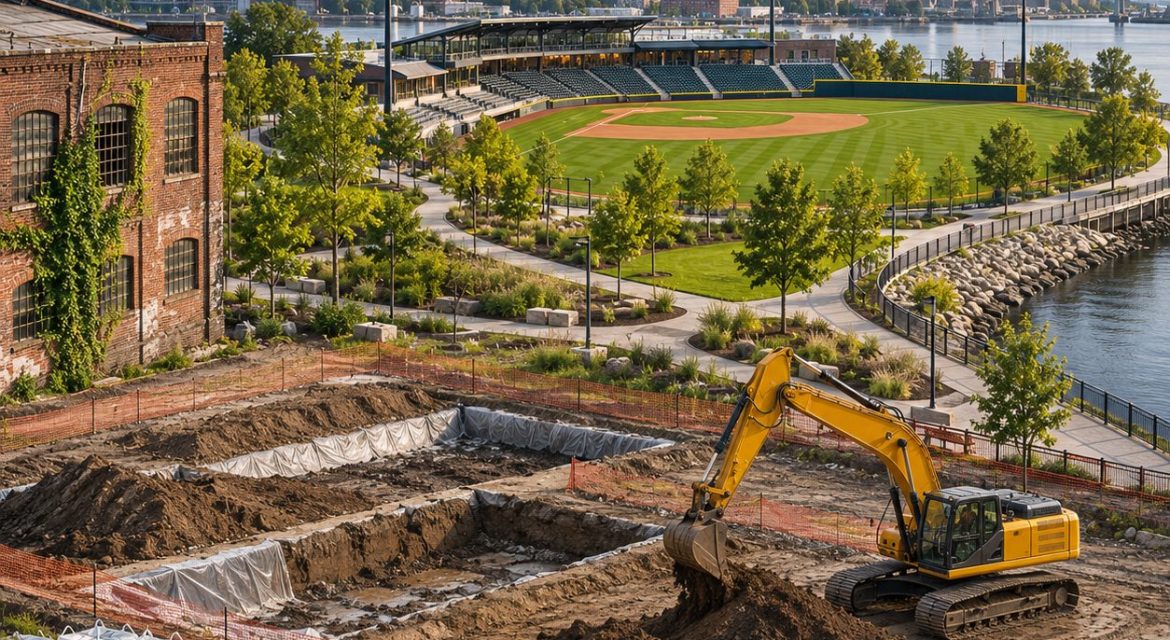
Each of these was a brownfield: land where redevelopment is complicated by the presence of hazardous substances or contamination. And each transformation started the same way, long before the first ribbon cutting, with excavators, water treatment, soil testing and a lot of careful planning.
Here are five famous brownfield redevelopment stories, and the equipment and site work behind them.
1. Nationals Park, Washington, D.C.
Before: a stretch of the Anacostia waterfront in Southeast D.C. that included an asphalt plant, a trash-transfer station, light industry and warehouses.
After: Nationals Park, which opened in March 2008 and became the first major professional stadium in the U.S. to earn LEED certification. It was built in about 23 months.
The site work: the project went through the District’s Voluntary Cleanup Program. Contaminated soil was excavated to make room for the stadium, remaining contamination was capped, and a groundwater collection, filtration and treatment system was built into the stadium design. A stormwater system separates and treats wash water and rainwater to protect the Anacostia River.
The equipment story: a fast-track schedule on a contaminated urban site meant mass excavation and hauling, soil segregation and testing, dewatering and treatment, all coordinated with stadium construction. That combination of remediation and vertical construction on one tight schedule is where staging, logistics and fleet coordination matter most.
2. Queen Elizabeth Olympic Park, London
Before: about 2.5 square kilometers of the Lower Lea Valley in East London, contaminated by more than a century of industrial use with oil, petrol, tar, cyanide, arsenic and lead.
After: the main site of the London 2012 Olympic and Paralympic Games, now a park, sports venues and new neighborhoods.
The site work: it was the UK’s largest soil-washing operation. Two on-site “soil hospitals” and five soil-washing plants cleaned close to two million tonnes of soil, and more than 80 percent of contaminated soil was cleaned and reused on site. The project also treated more than 20 million gallons of contaminated groundwater.
The equipment story: treating soil on site instead of trucking it away meant fewer haul trips and more processing equipment: excavators feeding wash plants, screening and sorting equipment, bioremediation beds, water treatment and a careful system for tracking soil from excavation through treatment to reuse. It remains one of the best examples of how on-site treatment can turn contaminated material into a resource.
3. Atlantic Station, Atlanta
Before: the Atlantic Steel mill, which operated in Midtown Atlanta from 1901 until 1998 on a 138-acre site.
After: Atlantic Station, a mixed-use neighborhood of homes, offices, shops and parks. According to EPA, it is home to more than 5,000 residents and 11 acres of public parks. The project received the 2004 Phoenix Award as the best national brownfield redevelopment.
The site work: nearly a century of steel production left a site that needed extensive cleanup before redevelopment. The project worked with EPA under its Project XL program, which also recognized the air-quality benefits of building a dense, transit-connected neighborhood close to downtown.
The equipment story: large flat industrial sites like this mean big earthmoving: demolition, excavation and grading across more than 100 acres, utilities, roads and a new bridge connection, followed by years of vertical construction. Projects at this scale depend on fleet management and laydown planning across many phases and contractors.
4. Gas Works Park, Seattle
Before: a manufactured gas plant on the north shore of Lake Union that turned coal, and later oil, into gas from 1906 until 1956. Leaks and by-products contaminated soil and groundwater with benzene and polycyclic aromatic hydrocarbons.
After: Gas Works Park, which opened in 1975 and kept the rusting gas plant towers as a centerpiece. It is now listed on the National Register of Historic Places.
The site work: landscape architect Richard Haag chose to keep the industrial structures and treat the land in place using an early form of bioremediation. Later cleanup work, overseen by the Washington Department of Ecology, added protective barriers and clean soil caps over much of the park, and work continues on nearby sediment.
The equipment story: Gas Works is a reminder that remediation doesn’t always mean digging everything up. Capping, in-place treatment and long-term monitoring rely on placement and compaction equipment, monitoring wells and sampling, and a commitment to inspection for decades after the park opens.
5. Freshkills Park, Staten Island
Before: the Fresh Kills Landfill, once the largest landfill in the world, covering about 2,200 acres before it closed in 2001.
After: Freshkills Park, being developed in phases into a park almost three times the size of Central Park, the largest park built in New York City in more than a century.
The site work: the landfill mounds are sealed with an engineered cap that includes a gas venting layer, an impermeable liner, a drainage layer, protective soil and planting soil. A network of wells collects landfill gas, which is processed and sold as natural gas, and leachate is collected and treated.
The equipment story: capping a landfill this size takes enormous volumes of soil, geosynthetics and careful placement, with grading equipment, compactors, haul fleets and survey technology working to tight specifications. Gas and leachate systems need drilling, pumps and long-term operation. And the transformation is still underway, with full build-out planned for the 2030s.
What These Transformations Teach Us
A ballpark, an Olympic site, a neighborhood and two parks took very different paths, but they share a few lessons for anyone working on brownfield redevelopment:
- The cleanup is the first phase of construction. Remediation and redevelopment work best when they are planned together.
- There is more than one way to clean a site. Excavation, on-site treatment, capping and in-place treatment all show up in these stories.
- Water management is everywhere. Groundwater treatment, stormwater controls and leachate systems appear in almost every project.
- Logistics decide the schedule. Staging, haul routes and fleet coordination become critical when remediation and construction overlap.
- Some work never ends. Caps, monitoring and treatment systems often need attention for decades.
EPA’s Brownfields Program supports thousands of smaller redevelopments with the same lessons. For contractors, that means a steady pipeline of projects where equipment rental and fleet management, laydown yards and coordinated site support can make the difference. For the cost side, read The 5 Equipment Mistakes That Blow Up Remediation Budgets.
Frequently Asked Questions
What is a brownfield?
A brownfield is a property where expansion, redevelopment or reuse may be complicated by the presence or potential presence of a hazardous substance, pollutant or contaminant.
What is the difference between a brownfield and a Superfund site?
Superfund sites are generally the most seriously contaminated sites, addressed under federal CERCLA authority. Brownfields are typically less contaminated and are often cleaned up through state voluntary cleanup programs as part of redevelopment.
How are brownfields cleaned up?
Common methods include excavation and disposal, on-site soil treatment, capping, groundwater treatment and in-place treatment, often combined with long-term monitoring.
About Nimble Managed Services
Nimble is a government-certified small-business set-aside partner providing managed services to construction, engineering, environmental, federal and infrastructure contractors.
Nimble currently lists certifications including WOSB, EDWOSB, HUBZone, SDB, DBE and SBE, along with additional state and utility certifications. Its managed-service capabilities include equipment rental and fleet management, turnkey laydown yards, subcontract management, site services, construction technologies, sustainability support and compliance consulting.
Learn more about Nimble’s Small Business Advantage
Working on a brownfield redevelopment? Let’s talk through the cleanup phase, the build phase and the equipment and site support between them. Start a conversation with the Nimble team.