Part of our field series on equipping environmental remediation projects. See also: A Field Guide to Remediation Equipment by Contaminant
Walk onto a remediation project and your eye goes straight to the heavy equipment: the excavators, the haul trucks, the treatment systems humming in the corner. But look a little closer and you’ll see a second job site running underneath the first one.
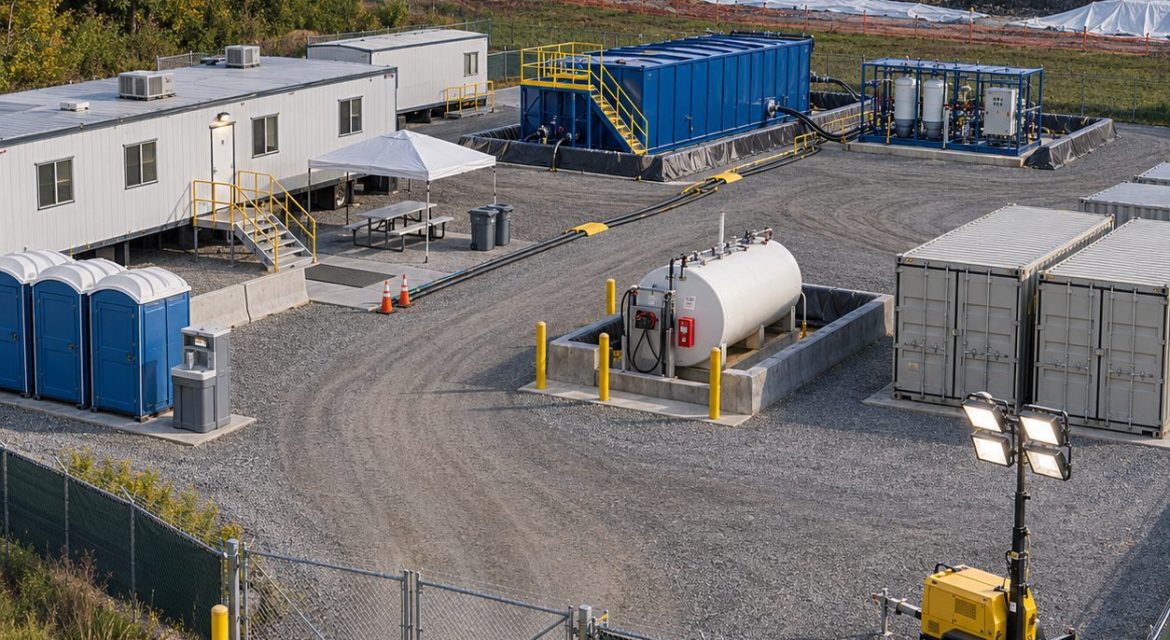
It’s the trailers and the toilets, the light towers and the fence line, the fuel truck that shows up at 5 a.m. and the frac tank nobody notices until it’s full. These are the remediation site services that keep the work moving. When they are planned well, nobody thinks about them. When they aren’t, they can stop a project cold.
Here are the 12 site services that make or break a remediation project, and what to get right on each one.
1. Laydown and Staging Yards
Every project needs somewhere to put equipment, materials, stockpiles and waste waiting for disposal. On remediation sites, staging areas often need liners, berms and stormwater controls. On tight urban sites, they may have to be off site altogether. A turnkey laydown yard can be set up, secured and managed for you.
2. Decontamination Stations
Every vehicle and worker leaving the exclusion zone has to be cleaned. That means decon pads, pressure washers, containment, sumps and water storage, all sized for peak traffic and bad weather. Decon capacity can limit production, so treat it as a production step.
3. Water Management and Treatment
Dewatering, decon water, stormwater and dust control water all have to be collected, stored, treated and discharged under permit. Pumps, frac tanks, weir tanks, filters and carbon vessels are standard. Always plan for backup capacity.
4. Temporary Power
Treatment systems, pumps, blowers, trailers and lighting all need power, often around the clock. Generators, fuel tanks, distribution panels and cabling need to be sized for the load, with backup for critical systems like dewatering.
5. Lighting
Short winter days, night shifts and 24-hour water treatment mean light towers are essential. Modern solar and hybrid light towers can reduce fuel use and noise, which matters near neighborhoods.
6. Fuel Management
Equipment fleets burn a lot of fuel, and running out stops work. Scheduled fuel delivery, on-site tanks with spill containment and telematics-based fuel tracking keep the fleet running and help control costs.
7. Office, Break and Storage Trailers
Project teams need offices, crews need clean break areas outside the exclusion zone, and tools and supplies need secure storage. Placement matters: support facilities belong in the clean zone, with clear paths that don’t cross contaminated areas.
8. Sanitation and Hygiene Facilities
Restrooms, handwashing stations and, on many hazardous waste sites, shower and change facilities are required for worker health. Servicing schedules need to keep up with crew size as the project grows.
9. Fencing, Security and Access Control
Contaminated sites have to keep the public out and track who comes in. Perimeter fencing, gates, signage, cameras and access control protect people, equipment and the project from liability.
10. Air Monitoring and Dust Control
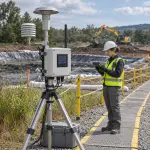
Real-time particulate and gas monitors at the work zone and perimeter, weather stations, water trucks and misting systems are standard on most remediation projects. They protect workers, satisfy regulators and keep neighbors confident in the work.
11. Worker Safety Systems
Remediation sites combine heavy equipment with hazardous materials, so safety goes beyond hard hats. Gas detection, proximity detection, PPE stations and connected safety tools all help. Our safety-as-a-service program bundles the equipment, training and monitoring, and our article on safety technology on job sites goes deeper.
12. Waste Containers and Logistics
Roll-offs, lined boxes, drums and bulk containers have to be on site when needed and gone when full. Waste often has to be characterized before it can leave, so staging and tracking matter. Missed pickups can shut down an excavation.
Why Site Services Get Missed
Site services rarely get the attention they deserve in a bid. They are spread across many line items, each one looks small, and they often get sourced late from whoever is available. The result is predictable:
- Rush delivery and minimum charges
- Duplicate mobilizations from multiple vendors
- Equipment that doesn’t match the site’s needs
- Hours of supervisor time spent coordinating vendors
- Gaps in critical systems when something fails
We told a few of those stories in When the Pump Fails at 2 A.M.
The Case for Consolidation
When site services come from one partner, the project team gets one point of contact, one delivery schedule and one invoice. Changes happen faster because the partner can see the whole site, not just one piece of it. And the site support plan can be built alongside the equipment rental and fleet management plan instead of after it.
There is a small-business angle too. Many federal, state and utility remediation contracts include small-business goals, and site services are a natural scope for a certified small business performing a commercially useful function. That gives primes a practical way to strengthen their SBE plan. Learn more in Beyond the Top 10: SBE Fulfillment.
Worker protection requirements for hazardous waste sites, including site control, decontamination and sanitation, are covered in OSHA’s HAZWOPER standard.
Frequently Asked Questions
What are site services in construction?
Site services are the support equipment and services that keep a job site running, such as trailers, sanitation, power, lighting, fencing, fuel, water, laydown space and waste containers.
Why are site services important on remediation projects?
Remediation sites have extra requirements like decontamination, water treatment, air monitoring and exclusion zones. When these services fail or arrive late, work stops and compliance is at risk.
Should site services be bundled with equipment rental?
Bundling site services with equipment rental reduces vendor count, simplifies coordination and invoicing, and makes it easier to scale support up or down as the project changes.
About Nimble Managed Services
Nimble is a government-certified small-business set-aside partner providing managed services to construction, engineering, environmental, federal and infrastructure contractors.
Nimble currently lists certifications including WOSB, EDWOSB, HUBZone, SDB, DBE and SBE, along with additional state and utility certifications. Its managed-service capabilities include equipment rental and fleet management, turnkey laydown yards, subcontract management, site services, construction technologies, sustainability support and compliance consulting.
Learn more about Nimble’s Small Business Advantage
Tired of managing a dozen vendors? Let’s talk about bringing your site services together under one plan. Start a conversation with the Nimble team.