Part of our field series on equipping environmental remediation projects. See also: The 5 Equipment Mistakes That Blow Up Remediation Budgets
Ask a remediation superintendent for a war story and you’ll rarely wait long. Everybody has one: the storm that came in sideways, the excavation that turned up something nobody expected, the phone call at 2 a.m. that started with “So, the pump…”
The stories below are composites, built from the kinds of situations that come up again and again on remediation job sites. The names and details are changed, and a few are stitched together from more than one project. But anyone who has worked in the field will recognize them. And every one carries a lesson about equipment and planning.
Tale #1: The Pump That Picked the Worst Possible Night
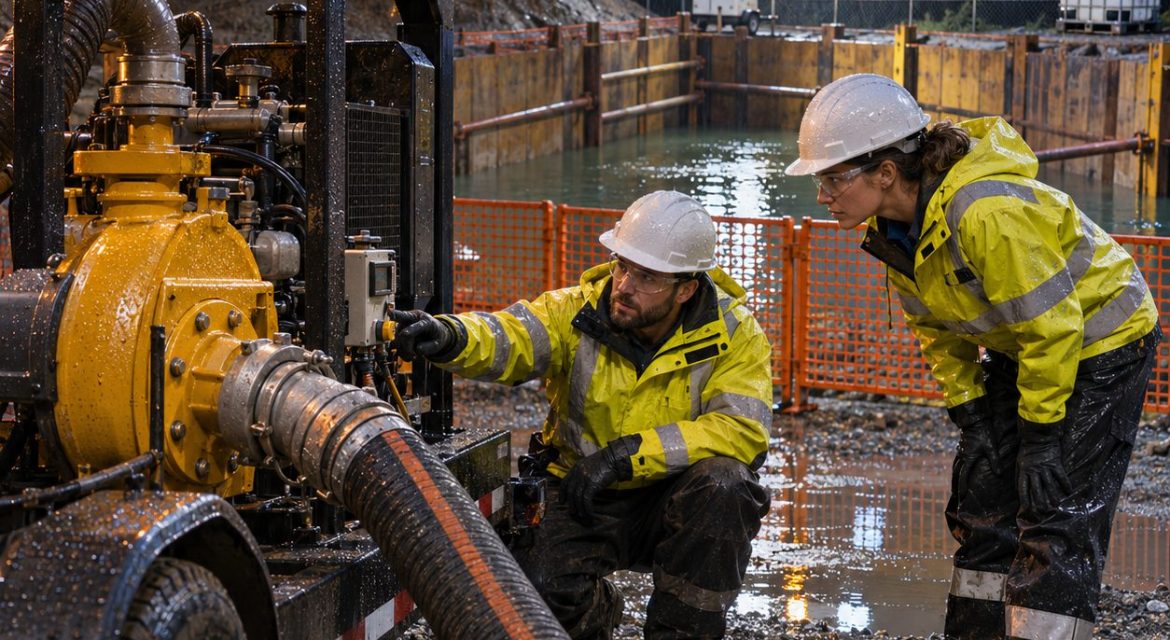
The excavation was deep, below the water table, and the dewatering system had been running perfectly for three weeks. Then a cold front rolled in with heavy rain. Around 2 a.m., the primary pump’s engine quit.
The night watch called the superintendent. The superintendent called the rental company. The rental company’s after-hours line went to voicemail. By the time a replacement pump arrived late the next morning, the cell had filled with several feet of contaminated water, the sidewalls were sloughing, and the crew spent most of the next week pumping, treating and re-excavating.
The lesson: on a contaminated excavation, the dewatering system is critical infrastructure. Plan for redundancy: a standby pump on site, automatic switchover or alarms, extra storage capacity in frac tanks, and a rental partner with real after-hours support and a known response time. The cost of a standby pump is small compared to a flooded cell.
Tale #2: The Drum Nobody Ordered
The site investigation said petroleum-impacted soil. Twelve feet down, an excavator operator felt the bucket hit something that wasn’t rock. It was a buried drum. Then another. Then several more.
Work stopped, as it should. The team set up an exclusion zone, called in specialists for sampling and characterization, and waited. The excavator, the loader, two haul trucks and the crew all sat idle for nine days while the drums were characterized and a work plan was approved.
The lesson: unknowns are part of remediation. Build contingency into the equipment plan and make sure your rental terms allow you to off-rent or swap equipment quickly when the schedule changes. Track utilization during the pause so idle equipment isn’t silently running up the bill. We cover that in detail in Beyond the Dashboard.
Tale #3: The Neighbor with the Video Camera
The project was a brownfield cleanup next to a residential neighborhood. On a dry, windy afternoon, a loader dumping soil into a haul truck sent up a visible plume of dust. A neighbor filmed it, posted it, and by the next morning the project had calls from the city, the regulator and a local news station.
Air monitoring showed the levels were within limits. But perception is real, and the project lost two days to meetings and a revised dust control plan.
The lesson: dust control and air monitoring are as much about community trust as compliance. Water trucks, misting cannons, wind screens and real-time perimeter monitors with alerts should be in place before work begins, and scaled up on windy days. Good monitoring data is also your best defense when someone raises a concern.
Tale #4: The Decon Pad That Washed Away
The decon pad was built quickly at the start of the job: some plastic, a few berms, a sump. It worked fine until the first big storm, when runoff overwhelmed the berms and carried sediment off the pad and across the haul road.
Now the team had a second problem to clean up, and equipment couldn’t leave the exclusion zone until a new pad was built. Haul trucks stacked up. Production stopped for most of a day.
The lesson: decontamination is a production step, not an afterthought. Design the decon area for the worst weather you can reasonably expect, with properly sized containment, sumps, pumps and water storage. Treat it as part of the equipment plan from day one.
Tale #5: The Twelve Vendors Problem
The project manager kept a spreadsheet of vendors. By the third month it had twelve: equipment, trailers, toilets, fencing, light towers, generators, fuel, frac tanks, filtration, water, waste containers and security. Every one had its own billing cycle, delivery schedule and phone number.
When the project needed to demobilize one area and remobilize another, it took a week of phone calls to coordinate. Two vendors delivered to the wrong gate. One trailer was billed for a month after it was picked up.
The lesson: fragmentation is expensive. Consolidating site support under one partner reduces coordination time, simplifies invoicing and gives the team a single number to call when plans change. That is the idea behind managed services, from equipment to a turnkey laydown yard.
What These Stories Have in Common
None of these tales involves a catastrophic failure or a careless crew. They involve normal remediation conditions: weather, unknowns, neighbors and logistics. What turned them into bad weeks was a lack of backup, flexibility or coordination.
The crews that handle these moments best tend to do a few things:
- They build redundancy into critical systems like dewatering, power and water treatment.
- They plan for unknowns, with contingency equipment and flexible rental terms.
- They put monitoring and controls in place before work starts, not after a complaint.
- They design decon and water handling for bad weather, not average weather.
- They work with partners who answer the phone at 2 a.m.
Good safety programs matter here too. Remediation sites fall under OSHA’s HAZWOPER requirements, and modern safety technology can catch problems before they become stories.
Your Turn
Every remediation job site produces a few stories. The goal is to make sure they are the kind you laugh about later, not the kind that show up in the cost report. If you have a field story of your own, we’d love to hear it. And if you are planning a project where a 2 a.m. pump failure would be a very bad night, it’s worth talking through the backup plan now.
For more on the cost side of these lessons, read The 5 Equipment Mistakes That Blow Up Remediation Budgets.
About Nimble Managed Services
Nimble is a government-certified small-business set-aside partner providing managed services to construction, engineering, environmental, federal and infrastructure contractors.
Nimble currently lists certifications including WOSB, EDWOSB, HUBZone, SDB, DBE and SBE, along with additional state and utility certifications. Its managed-service capabilities include equipment rental and fleet management, turnkey laydown yards, subcontract management, site services, construction technologies, sustainability support and compliance consulting.
Learn more about Nimble’s Small Business Advantage
Want fewer 2 a.m. phone calls on your next project? Let’s talk about backup equipment, response times and the support plan before you mobilize. Start a conversation with the Nimble team.