Construction and buildings account for roughly 37% of global CO2 emissions, according to the UN Environment Programme. Ninety percent of S&P 500 companies now publish ESG reports. Seventy percent of supply chain professionals expect increased ESG transparency demands from their customers. For general contractors working for major energy companies, federal agencies, or public utilities, this isn’t a future trend. It’s a current contract requirement.
What “carbon reporting” actually means on a construction project
Sustainability reporting at the project level is primarily about equipment emissions — the fuel burned by heavy machinery, trucks, and generators operating on site. The challenge is that a typical large construction project runs equipment from multiple vendors and rental sources, and that data lives in separate vendor portals that don’t aggregate automatically. Producing an accurate carbon report without a platform that consolidates telematics data across vendors means manually pulling numbers from multiple sources — which is why carbon reporting often either doesn’t happen or produces estimates that wouldn’t survive scrutiny.
How we handle it
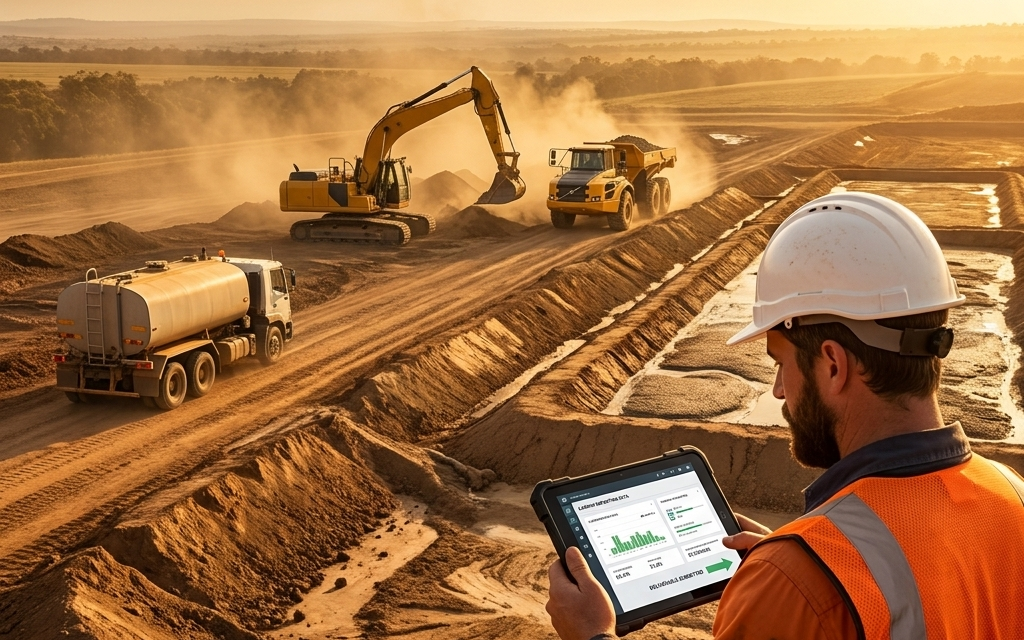
The Nimble Control Platform consolidates telematics data from multiple equipment vendors and client-owned machinery into a single reporting system. On the Pennsylvania remediation project, this enabled the project team to calculate carbon emissions and generate sustainability reports for their mining customer. The same system was deployed on the East Texas soil stabilization project, where routine carbon reporting to the oil and gas customer was a project requirement.
Why this is becoming non-negotiable
Federal contracting increasingly includes sustainability reporting as a deliverable, not an optional add-on. Contractors who treat carbon reporting as someone else’s problem are going to find it becomes their problem faster than expected. The better position is having the data infrastructure in place before the requirement arrives. The data is already being generated by the equipment. The question is whether it’s being captured in a way that produces a report anyone would trust.