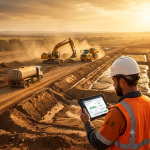
Technology Is the New Project Partner
Technology in environmental and infrastructure projects is no longer about innovation for innovation’s sake — it’s about precision, accountability, and speed.
Agencies and contractors now expect digital tools that can improve productivity, reduce risk, and document results with measurable accuracy.
From drones to GPS grade control to AI-driven safety and telematics, the modern job site has evolved into a network of intelligent systems — capturing data, predicting challenges, and driving smarter decisions.
A 2024 Engineering News-Record (ENR) Digital Construction Survey found that firms using connected technologies reduced rework by 28% and project administration time by 40%.
In other words, technology isn’t an upgrade — it’s a requirement.
1. Drones: Compliance from the Sky
Drones have become essential instruments for environmental consulting, restoration, and large-scale infrastructure projects.
They deliver a level of accuracy and efficiency that manual inspections simply can’t match — transforming how project teams plan, verify, and maintain quality control.
Key Benefits:
Progress Verification: High-resolution aerial imagery provides timestamped data for tracking project milestones.
Volume Tracking: Drones calculate material movement and site grading in real time, minimizing disputes over quantities.
Safety Enhancement: Aerial inspection reduces the need for personnel to access hazardous or unstable areas.
According to a 2023 Federal Highway Administration study, drone integration on infrastructure projects reduced field inspection hours by 38% while improving topographic accuracy.
For environmental consultants, this means greater visibility into sensitive ecosystems — and better data for restoration planning, reporting, and stakeholder transparency.
2. GPS Grade Control: Precision That Drives Performance
Precision is the heartbeat of every successful infrastructure project. GPS-enabled equipment now ensures that accuracy is built into every phase of grading, excavation, and material placement.
With grade control systems embedded directly in machinery, operators receive real-time feedback that minimizes errors, reduces material waste, and keeps crews aligned with project specifications.
Advantages:
Operational Accuracy: Reduces grading errors by 25–30%.
Efficiency Gains: Eliminates repetitive passes and shortens equipment run times.
Data Connectivity: Provides digital records of performance that can be integrated into scheduling and progress reports.
A 2023 National Institute of Building Sciences report found that GPS-controlled equipment improved overall productivity by 22% and cut idle time by 17% — measurable efficiency that translates directly to profitability.
3. AI Safety and Predictive Monitoring
Artificial Intelligence is redefining safety management across environmental and infrastructure projects. Sensors, cameras, and machine-learning algorithms now detect unsafe conditions, equipment malfunctions, and environmental risks before they escalate into incidents.
The Results (U.S. Bureau of Labor Statistics, 2023):
Job sites using AI-assisted safety monitoring reported 35% fewer OSHA-recordable incidents.
Lost-time injury costs decreased by an average of $92,000 per project.
AI-powered analytics also monitor air quality, noise, and emissions, ensuring projects meet sustainability benchmarks while protecting field teams.
By turning job sites into proactive ecosystems, technology is eliminating blind spots — both operational and environmental.
4. Telematics and Equipment Intelligence: Turning Machines into Data Sources
Every modern machine on a job site is now a sensor in motion. Telematics systems collect and transmit critical data points — location, fuel consumption, idle time, and engine performance — giving project managers a live dashboard of their fleet’s health and productivity.
Core Capabilities:
GPS-based tracking and utilization metrics.
Automatic service and maintenance alerts.
Real-time emissions and fuel-efficiency reporting.
Data-driven decision-making for fleet allocation and scheduling.
According to the EPA’s 2023 Clean Fleet Study, projects that fully adopted telematics reduced fuel waste by 18% and cut carbon emissions by 11%. For contractors, that means lower costs, longer equipment life, and a measurable contribution to sustainability goals.
5. Unified Systems: Technology That Works Together
The true advantage of digital transformation lies in integration. When drones, GPS systems, telematics, and AI safety platforms all operate within a unified ecosystem, data silos disappear — and project managers gain full operational visibility.
This interconnected approach allows decisions to be made with complete context: equipment efficiency, environmental impact, and labor productivity all visible in real time.
A 2024 McKinsey Infrastructure Report found that organizations using integrated digital ecosystems improved project delivery timelines by 20% on average and reduced unplanned downtime by 30%.
Technology works best when it works together. The future of environmental and infrastructure contracting will depend less on who has the best tool — and more on who can integrate those tools into a single, intelligent system.
6. Case Example: Building the Digitally Connected Job Site
A regional environmental engineering firm recently integrated drone mapping, GPS grade control, and fleet telematics into a wetland restoration program spanning 200 acres.
By connecting all three systems through an enterprise management platform, the project team achieved:
19% faster field data collection.
25% reduction in equipment idle time.
20% fewer material overages.
Real-time reporting dashboards for stakeholders and regulators.
The project’s digital ecosystem didn’t just enhance documentation — it improved the work itself. Efficiency, safety, and sustainability all advanced together.
Conclusion: Building Smarter, Not Harder
The future of environmental and infrastructure projects will belong to those who treat technology as a strategic partner, not an accessory.
From aerial data to predictive analytics, the tools once seen as optional are now fundamental to how modern infrastructure gets built, monitored, and maintained.
Firms that invest in integrated systems today will set the performance standard tomorrow — not just for cost and schedule, but for safety, sustainability, and innovation.
In this new era, technology isn’t just supporting the work. It is the work.
About Nimble Managed Services
Nimble is your proven reliable, government certified, small business set-aside (SBSA) partner. Acting as an extension of your team, Nimble provides high-level reporting and consulting solutions. We are your single source for construction managed services for: Construction Equipment, Site Services, Advanced Technologies.
Certifications:
WOSB | EDWOSB | HUBZone | SDB | DBE (All 50 States) | SBE (All 50 States) | WBE | SB (CA) | SEED (SMUD)
Sources
Engineering News-Record (ENR) Digital Construction Survey – 2024
National Institute of Building Sciences Smart Construction Report – 2023
U.S. Bureau of Labor Statistics Safety Study – 2023
U.S. EPA Clean Fleet Study – 2023
U.S. DOT Inspector General CUF Compliance Audit – 2023