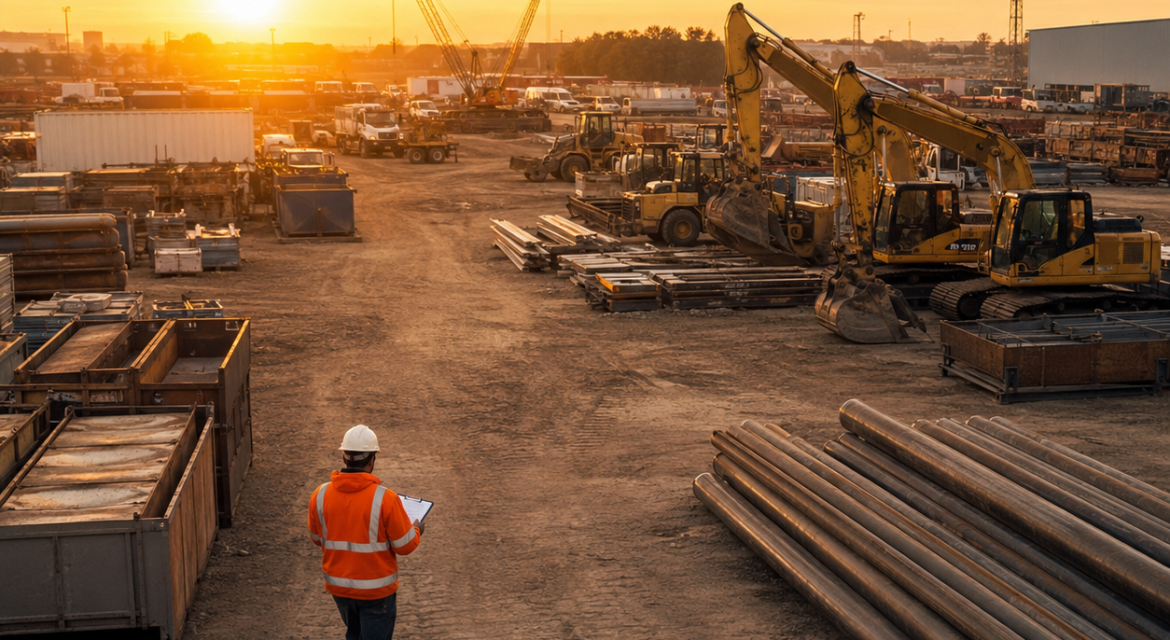
Most project delays don’t trace back to weather, permitting, or even labor shortages. They trace back to something far less dramatic: a worker walking back and forth across a disorganized yard, trying to find the right material or machine.
It’s not a glamorous problem. It’s also one of the most expensive ones on a job site.
The productivity number that should worry every PM
Industry studies on laydown yard operations have found that supervisors can lose roughly 35–45% of their time on non-productive tasks — chief among them, locating materials and equipment that should have been staged and ready. On a mid-sized project, recovering even 10% of that lost search time can translate into hundreds of labor hours recovered per month.
Run that forward across a multi-month federal or industrial project, and a poorly organized yard isn’t a minor inefficiency. It’s a recurring tax on every trade that touches the site.
Why this is getting harder, not easier
A few forces are converging to make yard management more complex than it was five years ago:
- The rental shift is accelerating. Industry analysts point to a continued move toward equipment rental and leasing models, driven by cost efficiency and flexibility — which means more equipment moving in and out of yards, more frequently, from more vendors. More transactions mean more opportunities for something to get lost, double-booked, or sit idle.
- Fleets are bigger and more varied. Construction companies today are rarely running one category of equipment. Between trucks, support gear, and specialty machinery, most contractors are juggling assets that used to live in entirely separate management systems — spreadsheets for one, whiteboards for another, phone calls to fill in the gaps.
- Telematics adoption is rising, but data alone doesn’t fix logistics. GPS tracking and remote monitoring are increasingly standard on rental equipment. That’s a real improvement for visibility — but knowing where an asset is doesn’t solve the underlying problem if the yard itself isn’t zoned, secured, and staged for how crews actually work.
What a well-run yard actually looks like
The fix isn’t complicated in concept, even if it’s tedious to execute consistently:
- Zonal organization — materials and equipment grouped by project phase or trade, not by whatever truck happened to drop them off first
- Defined traffic patterns — one-way routes, marked turning radii for delivery trucks and cranes, and clear separation between pedestrian and equipment paths
- Perimeter security and access control — particularly critical on federal and industrial sites where high-value equipment and compliance documentation both live in the yard
- Routine re-evaluation — a laydown plan that made sense at mobilization rarely still makes sense six months into a project; it needs to be revisited as scope shifts
Where this fits into the bigger picture
A laydown yard isn’t a side function — it’s the logistics backbone the rest of the project runs on. When it’s treated as an afterthought, the cost shows up everywhere else: in idle crews, in safety incidents from poor traffic flow, in equipment that gets re-rented because nobody could find the unit that was already on site.
This is exactly the kind of operational gap Nimble’s Turnkey Laydown Yard and Equipment Rental & Fleet Management services are built to close — bringing the zoning, security, and coordination discipline that turns a yard from a cost center into a project advantage.
Sources: industry laydown yard management studies; AEM and GlobalData construction equipment market analysis, 2025–2026